We’re Only Five

Fifty years ago I was teaching kindergarten at Colorado Academy in Denver.  We had a wonderful program for four- and five-year-olds in a supportive and exciting school. Housed in a converted apartment, my two co-teachers and I had plenty of classroom and outdoor space to explore and foster learning of all sorts.  Sometimes the lessons came from the students.

One random day, my colleague and I were returning from a gym class, wandering across campus, when we came across a young man in a wheelchair. Probably a veteran of the Vietnam War, he clearly had no legs and became an instant source of fascination for our young children. Some of them were not kind as they observed what might well have been their first wheelchair occupant.

In somewhat of a fury (I was still quite young myself), I marched our kiddos back to our PreSchool building, where I sat them down and proceeded to express my indignation that they would treat a fellow human so disrespectfully. I have no idea how long I spouted, until one little fellow finally raised his hand.  When I called upon him, he simply said, “Mrs. Glass, we are only five.”

He was correct. I apologized and shut up.  That little boy has no idea what an impact he had on me then and for the rest of my career. Children are remarkably generous. We adults have much to learn from them.

Teachers Who Make a Difference

Summer is about over for teachers and students – fully over for many. Time to consider the year ahead when one carries the responsibilities of running a classroom.

I believe we do our best work in our classrooms when we consciously emulate those who inspired us to teach in the first place. We need to create our own classroom worlds (more on that in a future essay), as it were, but, much like taking a good recipe and making it our own, it’s helpful to have a list of essential basic ingredients. New teachers may be daunted but what lies ahead of them; reflecting on the why and how of their own favorite educators can create a solid foundation for the year to come.

The schools I attended, both public and private, were good ones, as were the teachers I was provided. Mr. Robert Townsend was Principal of San Antonia School, in Ojai, California, as well as the teacher of 6th grade and half of 5th. I was fortunate to have him for both of those years.

Mr. Townsend was funny, in charge, knowledgeable, organized, and involved. He did not brook disruption or lack of respect. Mr. Townsend gave us responsibility and taught us important lessons about good delegation. As Principal in our small school, I’m not sure he even had a secretary. Faculty numbered five, I believe (so hard to imagine now!). Did they ever really get a break during a school day? I don’t know, but coffee was important. Mr. Townsend taught two other girls and me how to make coffee every morning. One less job for which he or a teacher had to be responsible. I still treasure the sound and smell of a newly opened can of Folgers!

sHe also ensured that two of the boys and I could run all of the audiovisual equipment (movie, film strip, and slide projectors). When another class wanted to watch something, he would send one of us to set up the equipment and make sure it ran smoothly. While I was not aware of it at the time, likely we three were all in good academic standing, since we had to miss some class time. Nothing to that effect was ever said; we simply knew it was our responsibility to make up anything we had missed.

Mr. Townsend played games with us, especially Kick the Can, often with other classes. I can still see him peeking around the trunk of a large tree, waiting for his moment.

My 6th grade year, the class was divided into threesomes to create our own science projects. Without ever saying anything to the two of us, Mr. T partnered Nelson Chase – one of my best friends – and me with classmate Sharon. We knew, on some unspoken level, that Sharon was not born with what I like to call a “school mind.” Long before the years of Special Ed and IEPs, Sharon was simply a full member of our class who must have required extra diligence from all of her teachers. Because of the respect with which Mr. Townsend ran his own classroom and the absolute lack of tolerance demonstrated by all teachers for any bullying on our little campus, there was no need for conversation as to our team makeup. Nelson and I never discussed it, but we knew the privilege of our partnership came with the expectation that we would include Sharon happily and fully. We had fun and worked hard in designing and creating an experiment in erosion that actually failed miserably in the intended sense. Who knew that our dry dirt playing field would not only not erode faster than the grassy comparison plot, but that it would quickly sprout its own grass when watered?

Fall of 1959, my 6th grade year, the newly moved-from-Brooklyn Los Angeles Dodgers played the Chicago White Sox in the World Series. Mr. Townsend was a big baseball fan. All Series games were day games. What to do? Bring his personal television in to the classroom. Create an educational experience by teaching all of us how to keep score. Ten years later, my now-husband was impressed that I could do so. Thirty years after that, I frequently assisted coaches at various schools by keeping the book for their teams, a connection that made the bridge between classrooms and playing fields a far more positive one than it might have been.

I never had a chance to thank Mr. Townsend for the many ways he impacted my life as a person and as an educator. He died far too young. But I thanked him every year as I described the above examples of Good Teacher to my colleagues. I hope that I emulated his respect and his humor and his trust.
Allison Wastes Time

When our younger daughter was in third grade, my husband and I attended a parent conference in which we were informed that Allison “wastes time.” A bright and capable girl she, her teacher’s observation puzzled me, and I asked for examples. Mrs. H could provide them easily: “Oh, she gets up and sharpens her pencil several times during a class. She often goes to the bathroom and is slow to return.”

On our way home that afternoon, I shared Mrs. H’s perceptions with Allison, who was quick to confirm them. She even provided identical examples.  When I asked why she wasted time, she replied with all the brilliant insight of an observant eight-year-old: “If I finish my work too quickly, Mrs. H just gives me more dittos.”

Conversely, two years later Allison had a fifth grade teacher whom she loved and for whom she would do anything. Mrs. W was tough, and she knew her students. Students who worked quickly and carefully would be given enrichment activities that were both fun and challenging. For instance, when the class was studying Egypt, Allison and a couple of others who were very capable students used their extra time to build a mummy, with the help of an art teacher. Ultimately, that mummy was buried somewhere on the campus, and the entire class participated in an “archeological dig” to unearth and study it.

I was never as creative as Mrs. W, but students who finished their work in a timely fashion could read a book of their choosing or play a quiet game. The system worked for everyone.

Alexandra

Our society is quick to recognize and applaud those who read early and those who read quickly. Sadly, that ability is too easily misconstrued as evidence of higher IQ and, equally damaging, greater maturity.  Too often, young children are “tracked” into classes based on their ability to read (aloud). Traditionally, early readers often skipped entire grades, only to run into unexpected walls later in their educational careers. It’s an easy assumption: If a child can read words aloud, s/he must be smart. And, of course, the converse: Slow readers must be, well, slow…

True teachers learn to recognize that trap with the help of students who are thoughtful, articulate, insightful, patient, and not necessarily speedy readers. I had such help early in my career, though it took Alexandra Smith in my 6th grade homeroom, to open my eyes fully. Alexandra was a brilliant young woman in many ways. When one considers multiple intelligences, her scores on any athletic field, her EQ, and her logic were tops. She was not a fast reader. She rarely raised her hand.  Not surprising, given that a majority of teachers (at that time, at least) generally called on the first hands raised. Judging from previous report cards, teachers liked Alexandra – she was no trouble, after all – but few recognized her potential.

For reasons I cannot remember, I started calling on Alexandra, allowing her time to consider her response. Sometimes I gave her advance notice (“Zander,  tomorrow I’m going to ask you what you think about X.”); sometimes not. Her answers were stunning: detailed, supported, connecting dots few others had even seen. Zander was a “slow reader” because she read every word and thought about them all. She remains one of the most thoughtful and insightful students I’ve ever had in class.

We have so much to learn from our students. Ask kiddos how they learn best, and they will tell you. Pay attention. Give everyone time to process. Listen to the levels on which they think. Set the expectation in your classrooms that you are not looking for speed; you are looking for insight and logic, thought and questions.

My granddaughter did not have an easy time learning to read. She is quick, curious, uses a stunning vocabulary, can reason with the best of them. But reading was hard, and she was self-conscious of that. Fortunately, she has been blessed by a school and teachers who recognized both her strengths and her challenges early on. She was neither tracked nor typed. She did receive helpful one-on-one time. Her parents supported and applauded her for who she is. Were you to have a conversation with her, you would never guess that reading had been difficult. She speaks using sentence structure, grammar, and vocabulary that suggest a much older child. Thank goodness she is recognized and appreciated for who  and what she is, not who and what she isn’t. And thank goodness for Harry Potter, who ultimately engaged her so completely, that her ability to read suddenly and fully fell into place.

I Don’t Know

A couple of weeks ago I wrote about a memorable, eye-opening, experience with a wonderful 8th grade boy at The Langley School in Virginia. In that blog, I referenced another occasion of equal impact.

Another of our 8th grade students, a young man from inner city Alexandria, missed school the day after Thanksgiving vacation because one of his friends in his community had been shot and killed. This was the second occasion where  someone about Keith’s age had  been murdered.

The next day, Keith was back in school. It was my practice, as Head of the Middle School, to visit each classroom first period every day. Doing so gave me a chance to observe teachers and students in action, as well as to touch base with kiddos who might need a bit of extra support.

On this particular morning, the rest of the 8th grade had assembled as a group for some special exercise about which I remember nothing. What I do recall is one very mature Black kid sitting at the front of his empty classroom, head down, weeping. His teacher was there but didn’t know what to say or do. Neither did I, but I did know that sitting with Keith was the first step.  I will carry the image of this wonderful young man, head down, disconsolate, for the rest of my life.

After expressing condolences, I thought to ask Keith if he were afraid this might happen to him. At first he said no. Then he paused, shuddered, and quietly replied, “I don’t know.” 

“I don’t know.” Not a question for any of the White kids in our school, nor for their teachers. Keith’s “I don’t know” should be a reminder of the uncertainty with which so many live. None of us “knows” what might happen any given day, but most of us don’t have to consider that violence could easily have a role. At least that was true two decades ago in Virginia, if one were White.

The Only Time My Classmate Know

During my long career as an educator, I was fortunate to work for and with colleagues for whom the practice of inclusivity was important. Some of my very best teachers were my students, who were willing to be honest. On this Martin Luther King Jr. day of recognition and celebration, I recall with deep appreciation and considerable pain two of those students. I will share one story today and one in future writing.

At The Langley School in McLean, Virginia, our 8th graders’ history course included a major unit on World War II. Among other things, we read Night, by Elie Wiesel, and Hiroshima, by John Hersey. In follow up to the latter, the students debated whether or not the bomb should have been dropped. They were stunned one year when a girl of Japanese heritage argued in the affirmative. Her parents felt lives had been saved.

In follow up to Night, every year we held an Outcast Simulation. Over the course of a month, one day each week I would enter the classrooms and declare that random students would be outcasts for the day. Generally, my reasons were something like, “Mr. Silvano, I have just realized that you have some students born in January and August. I’m not sure how that happened, but we all know that they should not be treated as full citizens.” 

For the rest of the day, the outcasts had to enter classrooms last, could be excluded from games at recess, and teachers (not their classmates) could make them do menial tasks around the classroom.  At the end of each Outcast day, I would invite those who had been excluded into my office to welcome them “back” and ask how the experience affected them.  As is their wont, kids were open and appreciative, but it was all part of a game.

I don’t remember specific comments until one young man, a boy of Color who had been with us for a few years said to me, “Mrs. Glass, this is the only time my classmates have experienced what it is like to be me.”

His comment had a huge impact on me then – and still does. This young man seemed an integral part of the class – and was, in many ways. But his experiences, especially outside of school, were markedly different from most of his classmates’ and teachers’.

In the wake of the murder of Renee Good, as White residents of Minneapolis react with understandable fear, we should all be reminded that those feelings and cautions are ones that People of Color experience every day.

Who Is It Funny For?

Parents can be a challenge for teachers. They can also be our best supporters. There are times when simply meeting with a parent – even more so, a couple – puts everything into perspective immediately. Hearing parents talk about their children is immensely informative. Not necessarily the what, but the how.

I do recall one mother who could drive me a bit crazy, as could her daughter. Quite likely, insecurity was her driving force, though the personalities for both came across as domineering.  I was surprised therefore, when this same mother gave me two of my favorite questions. We were talking about bullying and teasing and her daughter’s inclination to say, “I was just kidding.” This mother shared that her reaction to that response was always, “Well, who is it funny for?” Right to the heart of the matter, and a consideration that even fairly young children can appreciate.

The same mother also offered a wonderful defense for any child – or adult, for that matter – who is being teased or criticized for something. I learned from this mom to advise children who were teased for something out of their control like height, weight, accent, or other meaningless focus, to respond with, “Is that a problem for you?” Bullies have no idea how to deal with that.

The task of teaching children, whatever their ages, is ongoing. Whether we are parents, classroom teachers, or other adults in their lives, the challenge of helping them learn to be responsible and considerate citizens and friends is constant. Particularly in a time when adults are too often pitted against each other politically, and social media underscores division and allows anonymity, we can all be reminded of helpful responses. “Who is it funny for/” and “Is that a problem for you” work for any age.

Pink Pigs

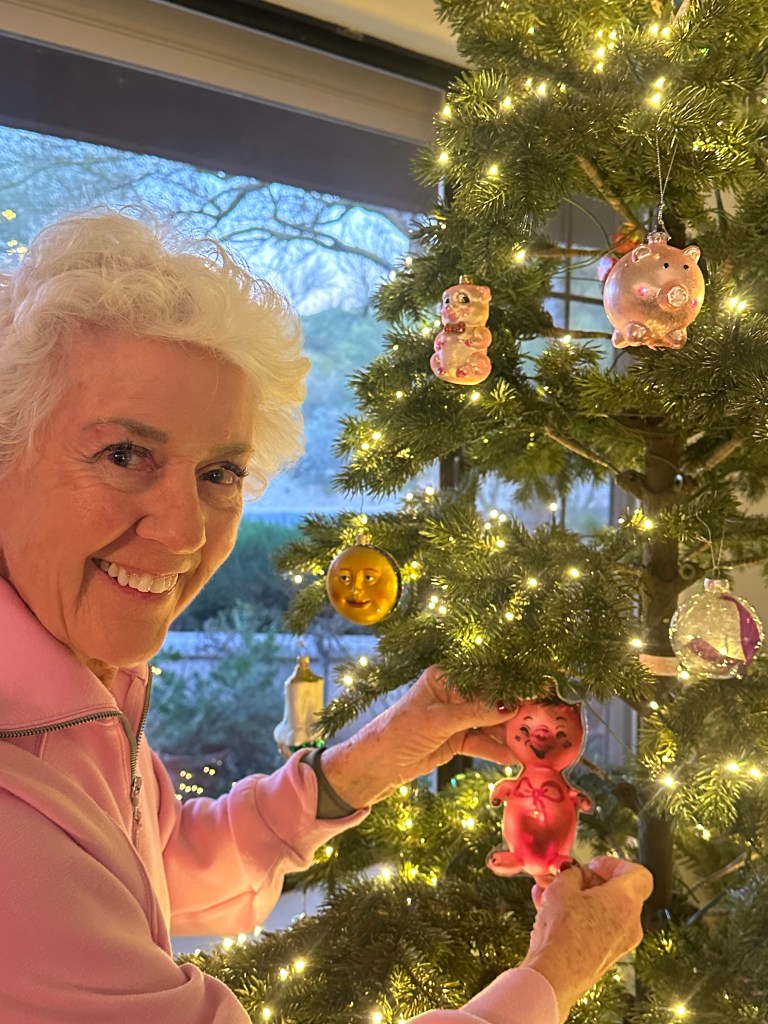
My favorite Christmas tree ornament may be a blown glass pink pig of questionable beauty. In fact, original said pig took a dive and smashed on the floor several years ago. In its place now hang a laminated photo of the original and two much prettier glass facsimiles. All three were lovingly and thoughtfully presented to me by friends after I posted on social media the demise of my first pig.

My guess is that part of the joy for all with holiday decorations are the memories we unbox each year. Teachers have an extra stash of connections — the gifts that we have been given by students over the years. I confess that, in many cases, I can no longer remember who presented me with many of the ornaments that I faithfully hang each year. Some include names and dates; many don’t. Each is a treasure. Especially the handcrafted ones. The ones that would never sell in a store but represent care and love and distinct creativity.The ones that continue to reflect the joy and excitement of the little faces who made and presented them.

Teddy Fonseca gave me that pink pig for Christmas in 1975 at Colorado Academy. Teddy was a chubby kid with wonderful black curls and a passion for lions. Teddy had trouble saying the letter “F,” which he substituted with “T.” Frequently, he was chosen to feed the fish in our kindergarten classroom. First, he would practice his “F” by saying ” FFFeed the FFFish.” Then he would “FFTeed the FFTish…” Retrospectively, I realize he may well have been playing with all of us. Teddy died as a young man. He lives every Christmas in our home.

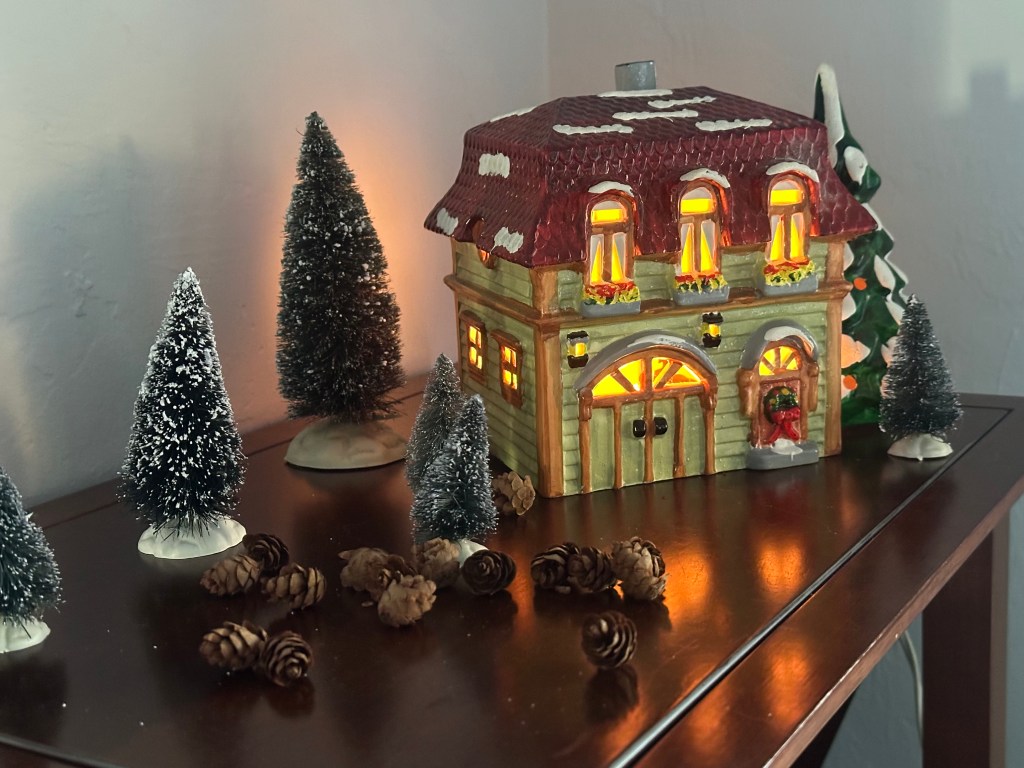
Billy Stone was one of my 6th grade students. Billy was easy: reliable, relatable, dependable, humorous, loyal. Not the “best” student in stereotypical terms, but certainly one who made my life and the classroom easier. At his middle school, he had trouble in math and a teacher who required a “Sacred Answer Column.” Billy’s father asked me to tutor his son, which was actually a pleasure. Too often, kids leave elementary and middle school and don’t stay in touch with their teachers. For Christmas that year, Billy gave me a wonderful little pottery house that lights up. His father said he hunted a long time until he was satisfied it was the right give. It was. It is. Our decorations are not complete until the “Billy House” is in place. I have lost touch with Bill Stone, but I think of him with love and appreciation every December.

Teachers work hard. Harder than anyone who has not created and maintained a classroom can possibly imagine. Many cultures around the world recognize and appreciate the importance and dedication of educators. Sadly, the US is not one of them, in general. But kids know. They know when they are seen and appreciated. They know when they are respected and understood. They know when a teacher provides a safe haven on a daily basis. Whether school is easy or a challenge, they know. To all of you out there unearthing your own Teddy and Billy memories, I salute you and share with you the unique delight that comes in the form of a pink pig or a pottery house from a kiddo you loved and still hold dear.

Full of Surprises

Those of us who teach and/or parent recognize the value of occasionally surprising the youngsters in our charge with hidden talents. Anyone over the age of about thirty is considered old. Keeping youngsters (and ourselves) on our toes is a good thing.

Almost thirty years ago, I started a new job at Columbus Academy in Gahanna, Ohio, as Middle School Head. The school had been all boys until a handful of years earlier and still maintained a fairly macho attitude. I was the first female to hold the Middle School Division Head title and responsibilities, and my immediate predecessors had not been good fits for the job. I suspected the 5th-8th grade students weren’t expecting much from me. I knew it was important to make the right first impression.

Regular assemblies were held in the school’s theater. 8th graders sat front and center, with 7th behind them and 5th and 6th classes off to the sides. 8th grade boys, as is often their wont, claimed the front row seats and demonstrated their social position by slouching in very male fashion. They were not disrespectful, but they made a statement with their posture. Asking or telling them to sit up straight was not going to have any real impact.

I elected to introduce myself by bringing a backpack on stage and informing the student body that I wanted to share some items that would tell them more about me. One at a time, I produced a picture of my family (husband and two grown daughters) who were not in Ohio, a laptop (technology fairly new at that time), a pair of Levi’s (we were a uniform school, which did not allow blue jeans for either students or adults). My audience was attentive, but the front row still slouched.

Then I suggested that there are things about each and all of us that are surprises. Things that we can’t surmise by looking at each other. For instance, as a middle-aged woman clothed neatly in a suit and heels, how could they possibly know that I was raised on a ranch in Wyoming? Whereupon, I pulled a bullwhip from my backpack. The front row sat up straight, immediately.

Very likely, in today’s environment, it would not be advisable to crack a bullwhip in front of 270 middle school kiddos and their teachers. I never repeated the act in schools that followed.  In 1997, I could get away with it – much to the delight of those students. A few days later, a group of 8th grade boys walked by the outside window of my office. As I glanced up, Ethan Robertson looked in and waved at me. Connections made.

Last week, I discovered that bullwhip. I am now seventy-seven.  I wondered if I could still crack it. The answer is yes. Sometimes we even surprise ourselves.

The Best Year Yet

I was never going to be a teacher. My father was a teacher. I knew at an early age what was involved in being a good teacher. Plus, as already noted, my father was a teacher… July 1, 2018 marked my retirement from 46 years as an educator: teacher, administrator, consultant. I could not have asked for a better, more fulfilling career. While I am happy to be retired, every year as the school year begins around the country, I am reminded of Dad’s commitment to create The Best Year yet. This year I am inspired to share some thoughts that might help current teachers accomplish just that.

Our culture does not, as a whole, respect or appreciate teachers as they deserve, and, frankly, that ignorance plays out in ways that too many people never stop to consider. I vividly recall a conversation with an international demographer whom I was to introduce at a major conference. When I wondered aloud what the impact on prison populations might be if all children in the United States (and their parents) had access to early childhood education, the thought had never occurred to him. To his credit, he responded with thoughtful surprise. But this man, who had studied national demographic trends for several decades, had never even considered an educational perspective.

Good teachers impact the lives of thousands of children over time. They make a difference in the ways young people learn to look at others and themselves. They teach children to think and communicate thoughtfully and critically, how to discern news that is fake from that which is real. Good teachers consistently and supportively insist that students be their best selves. They recognize and celebrate the uniqueness of each child and work extremely hard to develop strengths and interests and ameliorate weaknesses. Classrooms are microcosms of the societies around them. They should stress personal and group responsibility.

Teachers who create those positive, interactive environments benefit their charges at the moment and far into the future. I am constantly amazed when students I taught long ago share the impact that some experience had on them. Sometimes it was a specific lesson plan. Much more often, their memories center on bigger, ongoing conversations. They recall when a classmate’s father died unexpectedly and how we talked about it as a class, while their own parents didn’t know what to say. Neither did I, frankly, but when kids ask, teachers must respond. Former students refer to simulation exercises during which they were exposed to exclusion and its impact on everyone in the class. They laughingly remember learning how to diagram sentences, wondering how such drudgery (or delight, as some of them experienced it) would ever help them in life – then discovering the huge advantage they had when learning a foreign language or that their English grammar and writing skills were so much more advanced than their peers’ who had no clue about a participial phrase.

My classroom was my work, my playground, my joy, my challenge, my fulfillment. Hundreds of thousands of teachers around the country are assiduously planning for the school year ahead and the children for whom they will deeply care. The most significant way to help them is to give them our trust, support, and gratitude.