It’s Time

I haven’t written anything for this blog since the end of November. I’m not entirely sure why not. I maintain a running list of topics about which to write. Some are serious, some frivolous. Perhaps I have just been lazy; retirement can provide an odd mixture of Nothing and Everything To Do. Maybe I just needed a break. It’s time to write again.

The thing is, I have a voice and the means to use it, unlike millions in the United States who are both invisible and unable to speak, figuratively, if not literally. Consistent with terms and traditions we have all heard and used over the years without considering their implications, readers might remember that the inability to speak used to be referred as “dumb.” Consider how clueless we all were about the not-very-subtle message associated with that term. It is way past time that we thoughtfully examine myriad terms and references that we might have used thoughtlessly in the past. It can be argued that ignorance is bliss. While the learning curve is extremely steep for some, there is no longer an excuse for ignorance. No bliss.

We are in the middle of two pandemics — one created by a virus and spread through ignorance and selfishness, one created by injustice and spread through ignorance and fear. My voice is tiny and privileged. Using it may make no difference at all, but not using it is irresponsible.

I saw a wonderful post on Facebook today of a middle-aged or older gentleman in a wheelchair. Masked to protect others, he wore a t-shirt emblazoned with “Black Lives Matter.” The sign he carried proclaimed: “Sorry I’m late. I had a lot to learn.” We all have a lot to learn. It’s never too late.

I Should Have Stopped

Last summer, I was on my way to a women’s group lunch at St. John’s Episcopal Church in Jackson, Wyoming, when I passed a local resident speaking to a walking tour group he was leading. The fellow was probably about my age, dressed in western wear, and one might surmise, a local. While I cannot quote him directly, I was stunned to hear him refer to the beautiful church building and campus with this message: “It’s a shame that this property, in the middle of town, is wasted on a building that is used for only an hour a week.”

I considered stopping and correcting the fellow, then, as is my wont – and probably that of many – I figured it wasn’t my business. I have been bothered ever since that I did not have the courage to correct him, politely but firmly. St. John’s belongs just where it is because it has long been at the heart of this community. One hour a week? Nothing could be further from the truth.

The site of the main sanctuary and connecting rooms is where St. John’s Hospital resided until it was relocated. As a hospital, it welcomed and did its best to comfort and heal everyone who entered its doors. St. John’s Church continues that tradition. I am quite sure that I am not aware of all that St. John’s does to support the Jackson Hole community, but the following projects and activities take a great deal more than an hour a week:

The campus facilities, including the sanctuary, Hansen and Donnan Halls, are open to all who are involved and provide space for:

  • Browse and Buy
  • One-22
  • AA and other support group meetings on a daily basis
  • Jackson Food Cupboard
  • Bright Beginning PreSchool
  • Various meetings and discussions as requested by the larger community
  • Free family portraits for those who cannot afford them (provided by local photographers)
  • Monthly Mindfulness for Mamas meetings
  • Suicide prevention programs
  • Santa Fund
  • Angel Tree
  • Jewish community services
  • Grand Teton Music Festival monthly free concerts
  • Day of the Dead celebration and dinner presented jointly with local schools and Latino community
  • Partnership with Community Safety
  • Network: Movie and Discussion Nights
  • Free summer concerts featuring local musicians

Ongoing Church outreach projects include:

  • Hands-on support for Habitat for Humanity
  • Period Project
  • Blue Bag Project every November: Blue cloth grocery bags are filled with household needs and donated to families
  • If You Need Me, Take Me Coats (new and gently used coats are hung around the campus for those who cannot afford to buy their own)
  • Adopt A Family for the Christmas season
  • Laundry Love (donations of money and time allow locals in need to meet at the laundromat one night a week, where church volunteers provide detergent and coins to operate the machines)
  • Wind River Reservation Projects
  • Diapers and toys for babies and children
  • Tea and Talk at Legacy
  • Afternoon snacks at the library for school children
  • Season of Light Project with Lower Valley Energy

In short, there is never a need, identified by the greater community, to which St. John’s does not respond with open doors and open hearts. Had I shared even some of the above with the group of tourists gathered, not to mention the ill-informed guide, I might have opened another heart, another door. I should have stopped.


Do They Remember?

Recently my husband and I saw the movie “Harriet.” Powerful, brutal, beautifully acted and filmed, it should be required viewing for all. The theme should also be ancient history. Sadly, it is not. As a country, yes, we have made progress in some ways, but it’s not nearly enough. “Harriet” reminds us of the work we all need to do.

Watching the movie prompted me to think of several moments in my teaching career when the subjects of slavery/race/prejudice/bias and the whitewashing of history were central to our discussions. One occurred during my initial year teaching 6thgrade. We were studying US history. Our text, from an established publishing house, contained the briefest of mentions of slavery. While I cannot recall the exact words, one small paragraph described slaves as living in small cottages or cabins. There was no mention of anything remotely related even to hardships, much less brutality. Incensed, I assigned the class to do some research and rewrite the chapter. My students were receptive and interested. What they wrote was, of course, still far from reality. My hope was that they started to read history with minds more open to different perspectives and with an awareness of intentional misrepresentation.

A few years later and in another school, the 8thgrade teachers and I had created an Outcast Simulation to accompany the study of the Holocaust. Over the course of a month, one day each week we declared that some shared aspect (birth months, hair color, etc.) for a small group of students made them outcasts for the day. As such, they were not included in games, were the last to enter classrooms, had to pick up trash, and were completely ignored by their classmates, etc. Every student was an outcast at some point during the month. The experience was generally powerful. When I debriefed with the “outcasts” before they left for home, their observations were gratifyingly thoughtful. The most memorable moment came from one young African American boy who said, “Mrs. Glass, this is the only time in my life I think my classmates might have a tiny idea of what it is like to be Black.” This from a boy who was well-liked by and easy with his peers.

My final year in Virginia, one of our African American students missed the first day back from Thanksgiving break because an older boy in his neighborhood, someone he knew slightly, had been shot and killed. The second such instance in Keith’s life. During my morning classroom rounds, his teacher asked for my help. She needed to accompany the rest of the class elsewhere, and this young man clearly was struggling. To be honest, I had no idea what to say or do, so I simply sat down with him as he quietly wept. Finally, I asked him if he were afraid this would happen to him.” No.” (Pause.) “Maybe.” Therein lay the chasm that separated us. There was no way I could reassure him that it wouldn’t. His white classmates would never even consider the possibility. Fortunate through happenstance of birth; the kind of privilege most would never even recognize as such.

Teachers want to make a difference. We rarely know what sticks with our students, what interactions and discussions, what projects and questions will remain a part of their souls as they grow older. Were there times that made a difference in how they regarded and treated others as they matured? More often than not, the things they remember are likely things of which we were either unaware or have forgotten. I want to know: Does anyone remember those moments that have stayed with me for over forty years? Did they make a difference?

Thursdays at 2:00PM

I have a new favorite time of the week: 2:00-2:15 on Thursday afternoons. That magic quarter of an hour is when I read to Ms. Bliss’s second grade class at the Wilson Elementary School. Fifteen little charmers sit “crisscross applesauce” on their classroom rug, while I perch on a chair, holding aloft books I have checked out from the Teton County Library. Reading aloud to children will always be one of the most magical interactions in which people of any age can participate. This class is a delight.

It’s been awhile since I read to a group this age. I’m still settling on the appropriate level of reading material. The first week, I wondered if the books recommended by the town librarian were a bit too young. My instincts were correct, though the seven-year-olds were generous in their acceptance of what I brought. As is often the case, they are much more capable and curious than they are “supposed” to be. It was quickly obvious that their teachers recognize their talents and have exposed them to a wide range of concepts and experiences. The students told me their names, and we discussed what they planned to be for Halloween, which was that night. When I asked what they thought Ishould be, they agreed “a principal” would be perfect. What about a costume? Straight hair, dark lipstick, and a dress. I allowed as how straight hair would be a challenge for me. The week later, one of the boys sat down and announced, “You straightened your hair.” These kiddos do not miss a trick.

Children may have changed in many ways over the years since I began teaching, however, they remain as eager to hear and are as receptive as ever to a good story. They respond to the rhythm and cadence of words carefully chosen by an author. Morris McGurk and the Grinch, the Sneetches and Thidwick convey messages as timely now as they ever were. Horton first heard that little Who in 1954. Flopsy and Mopsy and Peter have been joined by Juana and Luca, Clifford, Captain Underpants, and, of course, Harry Potter and that Wimpy Kid. The book  review section of Sunday’s New York Times  includes a special ten-page insert devoted solely to children’s books. Recommendations start with picture books and end with timely young adult choices. There is no excuse not to read to and share books with children of any age.

Research over many years consistently reinforces the concept that reading aloud to children significantly affects their mastery of language and of literacy. Many parents stop reading aloud to their children when their youngsters start reading on their own. Don’t. My husband read to our girls into their upper elementary years. Father and daughters treasured the explorations and discussions connected to books both humorous and thoughtful. I recall with great pleasure (and some embarrassment) that my mother would read aloud to Dad, my brothers, and me on the frequent long road trips we took as a family. The embarrassment stems from the summer I was fifteen or sixteen and Mom shared James Bond. 007’s romantic trysts were just too much for me to hear my mother describe aloud. My guess is they were pretty tame, relative to today’s standards!

I love that Ms. Bliss’s 2ndgraders seem as eager as I to share whatever books I select. They remind me of the many years I taught middle school and would hear a student describe a book  to a classmate and say something along the lines of, “It’s great! Mrs. Glass recommended it to me.”  Find someone with whom to read. It’s a timeless gift.


Too Much Time

Asked what a friend who has been retired a number of years does in his “spare” time, he cheerfully responds, “Whatever I want to do.”  There are plenty of opportunities and choices available in retirement, I have discovered. Key pleasures include not arising at o’dark thirty; remaining in my pajamas until mid-morning; watching the sun rise while writing in my journal, a good cup of coffee in hand; entertaining luncheon guests mid-week; watching every game in the World Series without concern for late hour or work needing attention; hitting the gym at whatever hour is convenient. All in all, fourteen months (493 days, to be exact) into this stage of life, I am happy to report that my choice to retire remains a healthy and fulfilling one.

Which is not to suggest that I’ve got the new schedule and responsibilities perfectly aligned. Every day I create a To Do List, which includes the mundane (“Laundry,” which I am confident I will do) and the more aspirational. Every subsequent day I move at least a few things forward from the previous day. Sometimes more than once. Or twice. To be honest, “Blog” has reappeared with remarkable regularity since early summer. Why is that, I ask myself? For years I wrote a bi-weekly column for the Incline Village “Bonanza.” The deadline was noon on Mondays. Rarely did I miss one.

Now, I frequently think of topics of interest, some weighty, some frivolous. I make note of such topics in the “Lists” app on my phone. The list: 14; written blogs: 0. Clearly, I have too much time and not enough deadlines. Plus, I wonder who my audience might be. Ultimately, I have decided that it doesn’t matter whether or not anyone reads what I post. I miss the act of writing, of sharing musings on Life. So, I have created my own deadline: produce something every Friday. Let’s see how that works…

Mama Said…


IMG_0837.jpeg

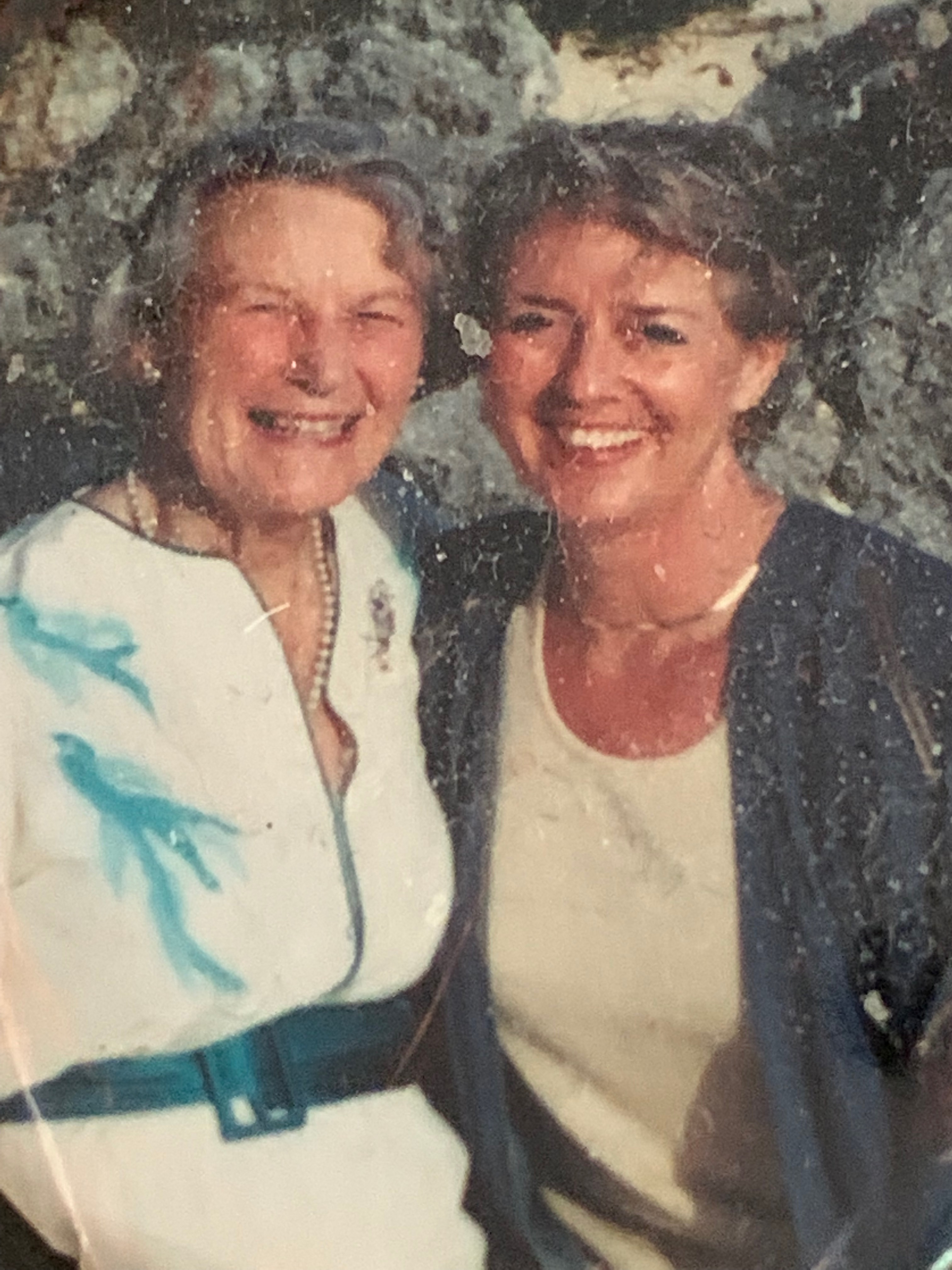
Mom and me on her 80th birthday.

(For those old enough to remember, this title comes from a song, sung by the Shirelles in 1960)

Not long ago, I volunteered for a Rotary work project that had a small crew of us transferring loads of bricks and concrete chunks from the terrace where they had been removed to the bed of a medium sized truck. As we settled into a steady rhythm, where three guys wheeled the barrows to two folks who lifted up two bricks at a time, to three women in the truck who rotated through positions of passing said bricks forward and arranging them in stacks of four, truck bed wide, I could hear my mother’s voice cheerily saying, “Many hands make light work!” When I shared this message with one group, somebody recalled his grandfather saying the same thing — from a chair where he observed others working.

Mom was an industrious, positive force who was not prone to giving lectures, yet managed to transfer indelible messages to her offspring. In addition to the observation about shared work, she was wont to say, “”Tis a mean bird who smears its own nest!” if she heard a family member or an employee badmouthing others, especially in public. Mom religiously cleaned up as she prepared meals, making the post-dinner task of doing the dishes (usually mine), much easier. I have learned to do the same for my husband.

Like most women of a certain age, I was cautioned to wear clean underwear at all times “in case you are in an accident.” One wonders why simply wearing clean underwear for its own sake wasn’t sufficient. A friend of mine notes that her mother added that the underwear should be pretty as well as clean, raising the question of intent. Did that particular mother see husband/partner material in EMTs in the case of an accident?

While Mom consistently stressed the need for self-sufficiency and independence, she was a loving and giving person who woke my brothers and me each morning cheerily saying:

“Rise, for the day is passing, while you lie dreaming on. Others have buckled their armor and forth to the fight have gone!”
or
“Good morning, good morning, ta-weet, ta-woo, buzz buzz.”

On another day, she might sing:

“Good morning to you, good morning to you, we’re all in our places with sunshiny faces, for this is the way to start a new day!”

Sunshiny faces were expected in our family. “Bad moods” were not tolerated. It’s not that feelings were disallowed, but grumpiness was not to be shared. Were any of us in a self-avowed bad mood, we were instructed either to go outside or to our rooms. Not a bad message, actually.

Mom believed in using the good silver and nice things for every day. I do the same. Perhaps that was part of her “Never put off until tomorrow what you can do today” philosophy, in addition to “let us live while we are yet alive,” which she and Dad modeled with significant energy and effect.

Family was all-important for Mom (and Dad). I remember countless family reunions that I didn’t particularly want to attend, but my parents insisted, saying that I would always be glad I did. They were correct.

Pondering the “little” things I learned from my mother that turned out to be big, I launched a little campaign to discover what others’ mothers had told them. In no particular order, but with a sense of shared delight, I heard the following:

“When you go out, (on a date, or even with your spouse) you should always tuck a little money in your shoe… that way if the date goes sour, you can always ditch the date and get yourself home.” The contributor thinks it was ultimately about teaching her independence (and maybe a little “planning for the worst.”)

“When things were not so good or I had enough of a negative situation, my mom said, and still says, ‘This too will pass!’

“Sarcasm is the lowest form of wit.” and “90% of what you worry about never happens.”

“Don’t bang your head against the wall because it feels good when you are done.”

“Smile and the world smiles with you.” and “The world does not revolve around you.” (Reported by the youngest of 6…)

“Don’t drive with girls in the car — they are very distracting.” Said to one fellow by his mother when he got his driver’s license. He claims he ignored the advice.

“You laugh and the world laughs with you; you cry, you cry alone.” and “It’s a blessed house where people feel welcome.”

When she was pregnant and asked her mother not to smoke around her, one woman’s mother replied, “ When I was pregnant with you, I smoked and drank and you turned out fine.” Hmmm

“My mother told/taught me many things, but one that stands out is, ‘The clothes make the man.’ Obviously, it didn’t stick, but I do think about it when I need to look sharp.”

“Teeth are jewels, not tools.”

“If you love what you do for a living, you will never work a day in your life.”

“Your friends are a reflection of who you are.”

“The hurrieder I go, the behinder I get.” “Were you born in a barn?” and reminded to eat because “there are starving people in China (or Africa or…). Plus the all important, “Toilet paper goes over the top.”

One mother advised her daughter to “leave things as she found them,” and also that, were she to get married, she should marry someone like her father.

Another friend announced that his mother said, “No!” a lot. Good mothers do that, in my opinion.

My husband’s mother always reported that it was “another damn beautiful day” in Albuquerque, regardless of the weather. He thinks it was a function of her being naughty and using a swear word. I think she wanted him to move back to New Mexico.
When I asked our two grown daughters what I had said that stuck with them, they were hard pressed to recall specific phrases, though they agree I delivered consistent messages about kindness and personal responsibility and perseverance. I suppose any of the sayings I used they credit to their grandmother, my mother, which is as it should be.

On the eve of this Mother’s Day, I hope all of you will stop for a minute or two and consider what your mother said or did that has stuck with you and helped make you the person you are today. I would love to hear what those things are.

Keenly aware that not all folks had the gift of reliable mothers or shared lives with them, I hope that someone in your life stepped into that void. To all mothers, mother figures, daughters, and sons, I wish for you a day of celebration and appreciation.


Am I an Ageist?

A few weeks ago,  my husband and I spent a wonderful week at The Villages in Florida with long-time friends. We had a glorious time playing golf, busing to a spring training game, and generally basking in weather much warmer and snow-free than has surrounded us at Lake Tahoe for the past few months. 

The Villages is basically an extended retirement community, accommodating well over 100,000 folks in a series of town centers and offering forty golf courses that range in length and challenge. I don’t know what the average age of its residents is, but Wayne and I, in our early seventies, were hardly on the upper end. Chatting with our friends, we all commented on how we were reluctant to live around “old people,” something we have noted for years. And which began to bother me more and more. Why, I asked myself, did I have this very clear bias? By the way, let’s get real: through the eyes of many, I’m an old person. So what gives? Am I not guilty of the very condescension and stereotyping that I disparage when it comes to talking about race or gender or sexual identity or any number of other attributes?

The reality of the stereotype of “old” has changed dramatically since our grandparents were “old” at 60. And were they truly much less capable at that age than we are now? While my grandfather died at age 65, he rode horses right to the end, despite crippling arthritis and heart disease. He trained his horse to kneel so that he could mount him. One of my grandmothers rode on her 80th birthday and boarded my brother’s motorcycle when she was 82. The other, widowed in her mid-60s, started an orphanage in Korea. My father stopped riding when he was 85, concerned that he might get hurt while mounting or dismounting and be a burden to my brothers and me. My mother’s diagnosis of Parkinson’s in her late 70s slowed her down in her early 80s, but she and Dad traveled the world — often on a standby basis — until that time. All were intellectually interested and interesting. When Dad’s arthritic hands curtailed his guitar playing, and his outstanding tenor voice began to wobble, he turned to storytelling. 

The Villages were a beehive of activity, with literally thousands of golf carts rushing from one golf course or town center to another. We saw more women on the courses than we have seen anywhere else. One can take classes in virtually anything, whether it be learning a new language, dance, yoga, billiards or pretty much everything imaginable. Bands play in the town centers virtually every evening, and each venue attracts a wide variety of entertainment from Russian ballet to current comedians. Everyone we met was very much alive and kicking.

None of us likes being stereotyped. When I find myself doing so in terms of those who share my age bracket, I know it’s time to get over my bad self. My father was fond of ending any table grace with the reminder to “live while we are yet alive.” Regardless of what age you are.

Conversation Between Two Mothers

On my way to Sun Valley for business a couple of weeks ago, I was able to stop for a quick visit in Boise to see a woman I have known all my life. Our parents were longtime colleagues and friends at the boarding school where I was raised. Alice and her husband were fifteen years younger than Mom and Dad. I am fifteen years younger than Alice. Her sons range from ten to fifteen years younger than I. Kind of a staircase of family relationships.

When I returned home for Christmas my first year of college, Alice and Bob told me I was then old enough to call them by their first names. Yikes: a definitive right of passage that I treasured then and try to provide for former students now. I’m old fashioned that way. As I recall, I used a variation of,“Hey, you” (but politely) for awhile, until I settled into a more comfortable relationship with my emerging adulthood. Then we became contemporaries.

When our girls were little, Alice and Bob’s boys were early adolescents. It was to Alice that I frequently turned for advice. Other than Dr. Spock’s book, to which my contemporaries turned for basic developmental information, our resources were the people we knew, not unknown authors or TV/lecture “experts.” In my very studied opinion, Alice’s boys were the kind of teenagers that I hoped our girls would become. As a family, they had fun together, travelled together, moved about the country together. Her children did not throw tantrums — at least that I ever witnessed. Nor did they whine and clamor for things they could not have. Alice informed me that she hated whining, and her consistent response to any son who tried wheedling was, “I can’t hear you when you are whining.” Not a bad strategy, I discovered.

My path and Alice’s criss-crossed over time, from Ojai, California, to Washington, DC, then back to California. I could always count on her to recommend an excellent book and to serve a fine dinner. She and her husband and my parents were closest of friends for over sixty-five years. In fact, Bob was a student of Dad’s his first year of Thacher. They shared glorious highs and significant lows of life across those decades, including their oldest son’s sudden death at age sixteen, Bob’s quick and devastating pancreatic cancer, and my mother’s gradual decline from Parkinson’s disease. One morning when my ninety-year old father was feeling uncharacteristically “fuzzy,” it was Alice whom he called and who rushed him to the hospital.

Alice is the one remaining parent. She lives in a memory care facility very close to her middle son. I hadn’t seen her since my father died five years ago and was not quite sure what to expect. Would she recognize me? Have any shared memories? As others whose memories come and go, Alice’s social skills remain finely tuned. Even as we spent time together, I wasn’t sure where I was on her radar screen. Both of her sons were with us that day — an extra treat that underscored the deep connections between our families. Their presence made for easy storytelling and fond reminiscences. Alice looked exactly as she always had and occasionally expressed a reaction, but I wasn’t sure if she really knew me.

The following week, when I visited again with her son and his wife, I asked if Alice had known who I was. “Oh, yes,” he smiled. “She talked about your visit the next day. Except that she felt you were much too old to be Ruthie. You must have been your mother.” It took me about two seconds to realize our visit had been the best possible. I got my desired visit with Alice (and her sons). Alice had a wonderful conversation with her dear friend Margaret, my mother, with whom she had not had a visit since 2005. What sweet moments life provides.

Good Snow Blowers Make Good Neighbors

We’d been gone for five months and were eager to get home. Driving across Wyoming, Idaho, Utah, and Nevada, the mountains were graced by snow, but the highways were blessedly clear and dry. In fact, it was not until we reached our street that we encountered patches of the white stuff. It was not until we reached our short, steep driveway that we were in trouble. Several inches of unplowed snow made it impossible to reach the garage. I tried, then slid back to the street. 

No problem, we thought; we purchased a snow blower last winter. It started easily, and my husband began clearing the driveway. It quickly became clear that the process was going to be a long one. Our machine couldn’t handle the amount of snow in clean sweeps. It would take two passes for each twelve-inch swath. We were looking at a couple of hours of work. We were almost home.

At about that time I noticed our neighbors’ clean, dry driveway and the impressively large snow blower resting just inside their open garage door. I figured asking to borrow it for a bit was a reasonable request, so knocked. These neighbors are relatively new to the street, and we had been gone. It was not as if we were old friends or even acquaintances. 

Jim didn’t hesitate. Instead of lending us the blower, he cranked it up and blasted through our impasse, throwing a stream of snow at least 30 feet. It took him maybe ten minutes to clear the way for both of our cars. What a welcome home. What a wonderfully neighborly thing to do. 

A month later, Incline Village has been smothered by several snow storms. The process of clearing driveways, stairs, decks, roofs, and hot tubs is shared by all residents; there is no escaping it. From the house-size Nevada snow plows to bobcats to pick-ups with blades attached to their front grill, from oversized to children’s shovels, on a day like today, everyone is working hard. Most people are also working to help others in some form.

There are those who are quick to criticize the public employees who maintain our highways and side streets. I am not among them. Time and again, I have watched these folks take the time, like our neighbor Jim, to stop and assist others. There is nothing as welcome as the giant blade of a massive snowplow gently easing into one’s driveway and taking with it the icy, 4-foot berm that is blocking the street. While I don’t recall the exact number, our little town’s streets add up to well over 1,000 miles, I believe. Those who keep them clear and the power running do not subscribe to a 9:00-5:00 kind of day. We who choose to live in wintry mountains should not be surprised when storms create inconvenience. Rather, we should be grateful for our good neighbors and their snowplows, metaphorical or real.

I Knew You’d Want To Know

Last week, on a bluebird Tahoe day, I went skiing. I’m retired and can do such a thing. Recent snowstorms had provided an excellent base across the mountain, and I thoroughly enjoyed the long, groomed runs that I prefer. The slopes were stunningly uncrowded. What a joy.

No crowds meant no lift lines and no particular reason to slow down, which also meant I was ready for a mid-morning break. There were two of us on the deck of Snowflake Lodge: a fellow about my age, who nodded cordially then sat quietly, and I, both of us basking in the always-astounding view of Lake Tahoe. 

We were enjoying our separate quiet spaces, when his cell phone rang, and he answered. While the deck was hardly private and we were seated not far from each other, I made a point of not listening to his conversation, though I noticed the tone was upbeat. Closing the call, he came over to me and said, “That was my sister. She was just told that her breast cancer is in remission. I knew you’d want to know.”

If this fellow and I had ever seen each other before, neither of us was aware of the fact. I have no idea who he was. Perhaps he figured I had been listening to his conversation. But he was correct, his news, his sister in North Carolina’s news, was absolutely something I was thrilled to hear. He had something big he needed to share, and I was the lucky person with whom he shared it.

There is power in good news, even among strangers. There are concerns and fears that we all share in some form or another. Similarly, there are joys and unexpected gifts. There was more in the moment than a brother celebrating out loud. He didn’t tell me he had great news he just had to voice. He said, with certainty, that he knew I would want to know. I suspect his reasoning included that I am a woman, and all women have some experience with breast cancer. He was so right. What a gift on a bluebird Tahoe day. May his sister live for many years to come.